eBay scams every buyer and seller should know
eBay has been running since 1995 and serves over 130 million active buyers, and unlike a local marketplace, it comes with real buyer protection built in. That protection is exactly what scammers work around. Roughly one in three buyers and one in five sellers on major second-hand platforms ran into a scam attempt between 2022 and 2024, and eBay’s own help pages devote entire sections to fraud.
So can you get scammed on eBay? Yes, on both sides of the deal. The catch is that almost every eBay scam depends on one thing: pulling you outside the platform’s protection, or abusing the fine print of it. Once you see that pattern, most of the tricks below become easy to spot. This guide covers the common scams against buyers and sellers, the warning signs, and how to get your money back if it already happened.
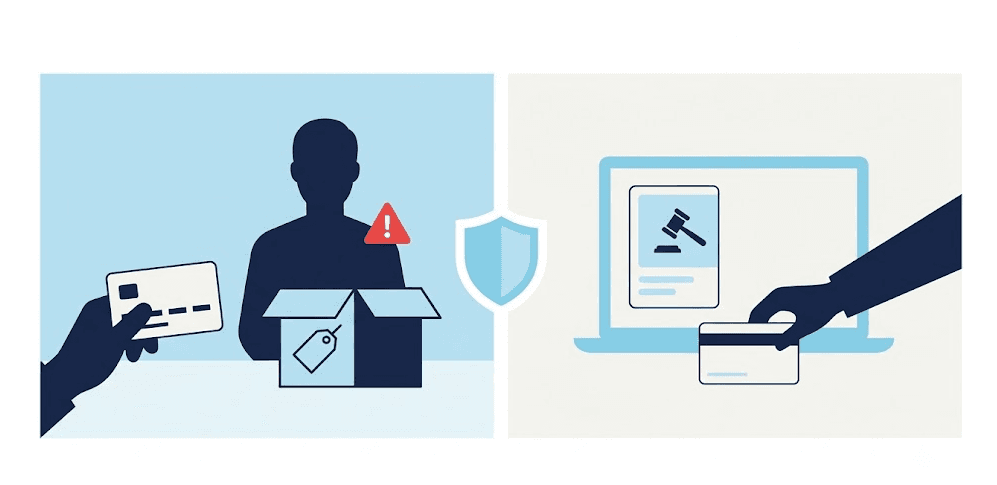
The two sides of eBay scams
Seller scams hit you when you’re buying. The listing is fake, the item is counterfeit, or the tracking number points somewhere that isn’t your house. The goal is your money or your card details.
Buyer scams hit you when you’re selling. The “buyer” wants the item without paying, or wants to weaponize eBay’s refund system against you.
The common thread on eBay specifically: the platform’s Money Back Guarantee actually works, so scammers either lure you off eBay where it doesn’t apply, or game the delivery and return process where it does. If you also sell locally, the same instincts transfer — see our guide to Facebook Marketplace scams, where there is no equivalent safety net.
Common seller scams (when you’re the buyer)
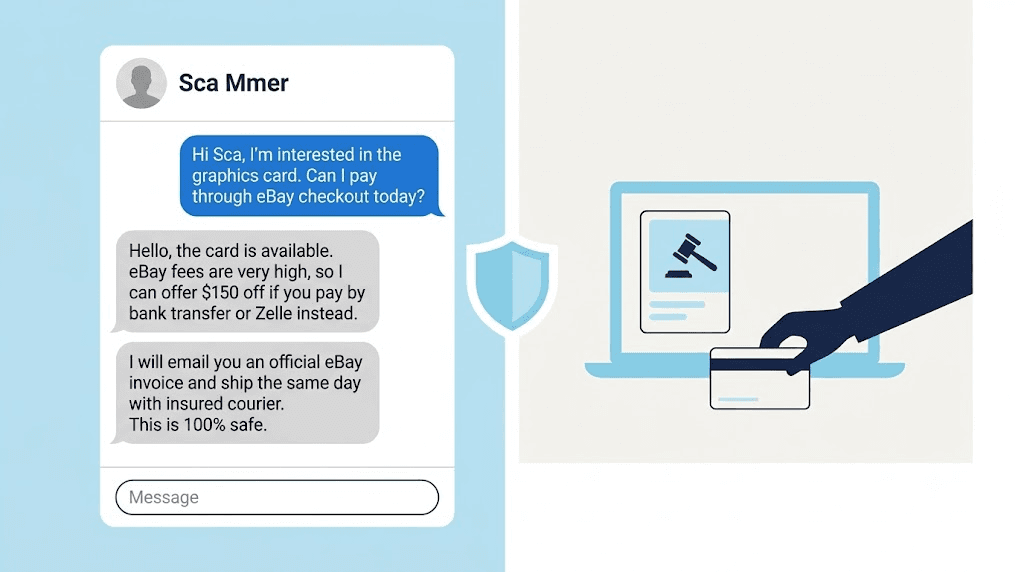
Photo-only and empty box listings
A hot item at a great price, and buried in the description: “photo only” or “box only.” You pay $2,000 and receive a printed picture of a graphics card, or an empty PS5 box. Technically the listing told you. Practically, it was written to be skimmed past. eBay bans these listings, so victims usually get refunded, but the fight takes weeks. Read the full description before hitting Buy It Now, especially on electronics and collectibles priced to make you rush.
Counterfeit items
Designer bags, sneakers, watches, trading cards, even networking equipment. The listing says authentic, the photos are stolen or generated, and the price sits just low enough to feel like a find rather than a fake. Check where the item ships from, run the photos through a reverse image search, and ask for a picture of the actual item with a handwritten note. Watch the feedback history too: scammers pad their rating with hundreds of cheap sales before listing the expensive fakes.
Fake tracking numbers
The nastiest one. The seller ships a cheap, empty package to a random address in your ZIP code. Carriers often confirm delivery only down to the ZIP, so eBay sees “delivered” and denies your claim. One Reddit user who bought a $2,000 camera this way got refunded only after a police report and repeated calls to the postal inspection service confirmed the package went elsewhere. If tracking says delivered and you have nothing, ask your local post office to confirm the exact delivery address and the package weight. That evidence wins appeals.
A package with the wrong name
The item arrives at your address, but it’s addressed to a stranger. The scammer wants you to assume a mix-up and send it back, because a returned or refused package removes you from Money Back Guarantee coverage and closes your right to dispute. Don’t refuse it and don’t return it. Open it, document what’s inside, and file “item not as described” through eBay if it’s not what you ordered.
Non-delivery of items the guarantee doesn’t cover
The Money Back Guarantee excludes whole categories: digital goods and NFTs, services, real estate, businesses, travel tickets, and vehicles (those fall under a separate Vehicle Purchase Protection program). Scammers deliberately sell in these categories, take the money, and vanish, because there’s no claim to file. Before buying anything unusual, check whether the category is covered at all.
Off-eBay payment offers
“eBay fees are killing me, pay by Zelle and I’ll knock off 15%.” The moment money moves outside eBay checkout, every protection disappears, and eBay’s policy explicitly says so. Wire transfers, gift cards, crypto, Venmo, and “PayPal friends and family” all belong to this scam. A real discount is never worth an unprotected payment to a stranger.
Fake second chance offers
eBay has a legitimate Second Chance Offer program for auction losers. Scammers copy it: you lose an auction, then an email arrives offering the item at your losing bid if you pay by wire or to a PayPal address. Real second chance offers show up inside your eBay Messages and under Bids/Offers in your account. If it only exists in your email inbox, it’s phishing. Forward it to [email protected].
eBay Motors scams
Cars are the big-ticket version of everything above. A vehicle listed far below market, a seller who’s deployed or handling an estate, a claim that the car sits “in an eBay warehouse” (eBay has no warehouses), and a request for payment or a deposit before you’ve seen anything. One British farmer, Simon Lane, found a John Deere tractor at a bargain price; the listing was fake, and he and 18 other buyers lost over £10,000 to the same scammer. Never pay for a vehicle you haven’t inspected, and complete the entire deal inside eBay.
Fake customer service numbers
You have a problem with an order, you google “eBay support phone number,” and you call a number scammers planted in search results or on a fake help page. The “agent” asks for your password, a verification code, or remote access to your computer. eBay’s real contact options live inside your account after you log in. Start there, always.
Triangulation fraud
You buy an item at a good price and it arrives brand new, shipped directly from Walmart or Best Buy. The seller bought it with a stolen credit card and pocketed your payment. You may keep the item for a while, but when the card owner files a chargeback, the purchase traces to your address. If your eBay order arrives as a retail shipment from a store you didn’t buy from, report it to eBay before it becomes your problem.
Common buyer scams (when you’re the seller)
Off-platform payment and overpayment tricks
A buyer offers to pay more if you cancel the listing and deal directly, or “accidentally” overpays and asks you to refund the difference by Venmo. The original payment is fake or will be reversed, and once you’ve left eBay, you have no seller protection and no evidence trail. Any overpayment means cancel the whole transaction.
False claims that the item never arrived
The buyer receives the package, then files “item not received” or a card chargeback anyway. Your defense is boring and effective: tracked shipping on every order, signature confirmation on anything valuable, and shipping only to the address on the order. With tracking that shows delivery to the buyer’s address, eBay’s seller protection sides with you.
Fake damage claims and AI photos
A newer version of the same move. The buyer photographs your item, feeds the photo to an AI tool, and sends back an image of it with a crack or a hole, demanding a partial refund. Sellers report this trick spreading on eBay and similar platforms. Photograph and film the item while packing it, down to serial numbers. Your “before” evidence beats their generated “after.”
Return fraud
The buyer opens a return and sends back a different item, a broken one, or an empty box, sometimes with the return label rerouted so tracking scans in your ZIP without reaching you. Film yourself opening returns, compare serial numbers, and refund only after you’ve checked what actually came back.
Stolen credit cards
The buyer pays instantly, full price, no questions. Weeks later the real cardholder disputes the charge and the payment claws back after your item is long gone. You can’t fully prevent this, but you can avoid feeding it: no off-platform payments, no shipping before payment clears, and extra caution with brand-new accounts buying high-value electronics.
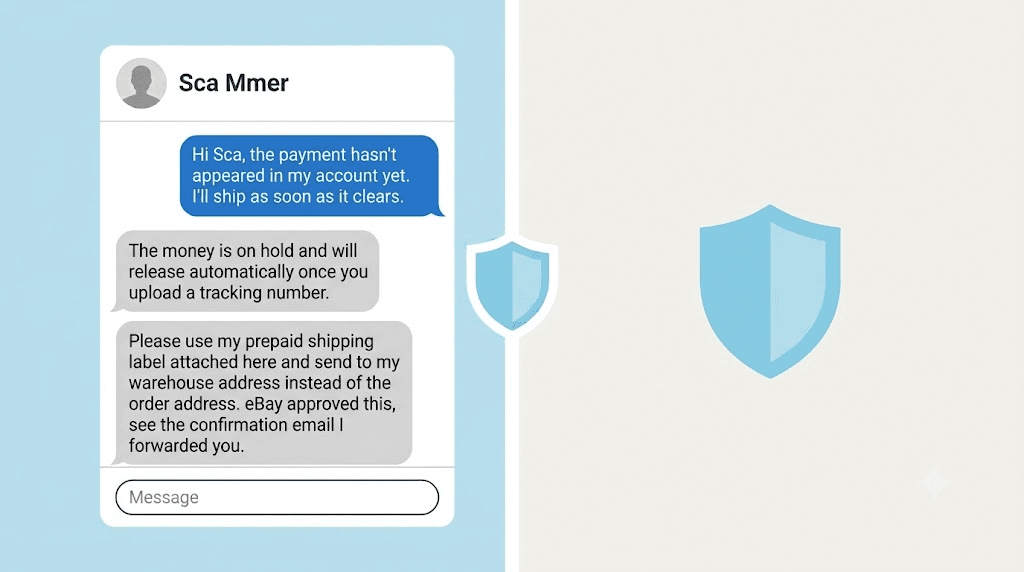
The buyer’s own shipping label
A buyer insists on emailing you a prepaid label, or asks you to ship to a different address after paying. Both kill your protection. Their label gives them control of the package (and may be bought with a stolen card), and shipping anywhere other than the order address voids eBay’s coverage. Buy your own postage. Ship only to the address on the order.
Feedback extortion
“Refund me 50% or I leave negative feedback.” That’s blackmail, and eBay prohibits it. Don’t negotiate with it. Screenshot the message and report the buyer; eBay removes extorted feedback and can sanction the account.
Bid shielding
An auction trick. One account places an absurdly high bid to scare off real bidders, then retracts at the last minute so an accomplice wins at a fraction of the price. If your auction gets a suspiciously high early bid from a fresh account, check the bid history and report retraction patterns to eBay.
Signs of an eBay scammer
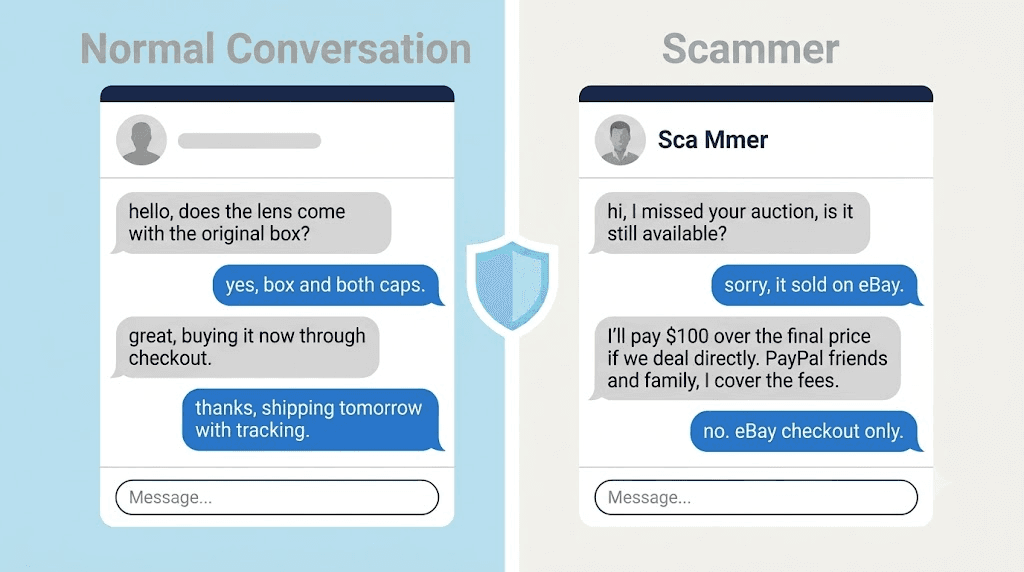
No single sign proves fraud, but these cluster together in almost every case.
They want to leave eBay. Off-platform payment, email negotiations, a phone number “to discuss.” This is the master red flag, because every other trick needs it to work. There is no honest reason a stranger insists on it.
The price is too good. A $2,000 camera for $700, a tractor at half market value. The discount exists to make you skip the checks.
The feedback doesn’t fit the listing. A brand-new account selling a Rolex. Or 400 positive reviews, all for $3 phone cases, and suddenly a $1,500 laptop. Padded feedback is a known setup move.
Stock, stolen, or AI photos. Reverse-search the images. A real seller can photograph the item next to a handwritten note.
Sob stories and urgency. Deployment, a sick relative, “another buyer waiting, decide in 10 minutes.” Pressure exists to stop you from thinking.
Strange payment or shipping requests. Gift cards, wire transfers, their own prepaid label, a different delivery address after payment.
Replies that ignore your questions. Template answers mean a script, and a script means volume fraud.
Safe buying rules on eBay
- Pay through eBay checkout, every time. This single habit keeps the Money Back Guarantee on your side and defeats most scams in this article at once.
- Read the entire listing, including item condition and the fine print, before bidding or buying.
- Check the seller before the price: feedback history, what they’ve sold before, account age, ship-from location.
- Keep all communication in eBay Messages. It’s your evidence.
- Never click payment links or “invoices” sent by email, and never call support numbers found outside ebay.com.
- For vehicles and anything above a few hundred dollars, inspect in person or walk away.
How to sell on eBay without getting scammed
- Ship only to the address on the order. No exceptions, no “cousin’s place,” no last-minute changes.
- Buy your own postage with tracking, and add signature confirmation for anything valuable.
- Wait for payment to actually clear before shipping. On-hold, pending, or “releases after tracking” means don’t ship.
- Document everything. Photograph the item, serials, and the packed box; film the packing on expensive orders.
- Refund returns only after inspecting them, on camera.
- Cancel any transaction with an overpayment or an off-platform request, and report the buyer.
- Never give in to feedback blackmail. Report it instead; eBay penalizes the buyer, not you.
What happens if you get scammed on eBay
It depends entirely on where the money moved.
If you paid through eBay checkout, the Money Back Guarantee applies. You report the problem, the seller gets 3 business days to fix it, and if they don’t, eBay steps in and usually decides within 48 hours. Refunds land back on your original payment method within about 3 to 5 business days. You have 30 days from the estimated delivery date to report an item that never arrived, and 30 days from delivery to report one that doesn’t match the listing. Miss the window and eBay can no longer force a refund.
If you paid outside eBay, the platform can’t help, and its policy says so plainly. Your only routes are your bank or card issuer, and for some payment types (gift cards, wire transfers) recovery is unlikely.
Sellers have a mirror-image system: seller protections for tracked shipments to the order address, and a process for reporting abusive buyers.
How to get money back from an eBay scammer
Work through these in order. The clock is the enemy, so start today.
1. Open a request on eBay. Go to your Purchases, find the order, and choose “I didn’t receive it” or “Return this item.” eBay requires you to contact the seller first; do it through this flow so everything is on record.
2. Escalate after 3 business days. If the seller stalls, refuses, or feeds you excuses, ask eBay to step in. Don’t let a scammer run out your 30-day window with “just wait a little longer.”
3. Appeal with hard evidence if you lose. You have 30 days to appeal a decision. For fake-tracking scams, a statement from your post office confirming the true delivery address and package weight is the strongest card you can play. One buyer of a never-delivered pool won her case after the post office confirmed the “delivered” package weighed two pounds.
4. Go to your payment provider. Card payments can be disputed as a chargeback, typically within 120 days. PayPal purchases carry their own 180-day protection through the Resolution Center. This route works even when eBay’s case went against you.
5. Report the account and any phishing. Report the seller or buyer through eBay’s help pages, and forward fake emails to [email protected]. It won’t refund you directly, but it takes the account down and supports your dispute.
6. Report it to the authorities. In the US, reportfraud.ftc.gov and ic3.gov. In the UK, Action Fraud. Keep the report number; banks ask for it.
7. Secure your accounts. If you clicked a link or shared a code, change your eBay and email passwords and turn on two-factor authentication.
8. Save everything first. Screenshots of the listing, the seller profile, messages, tracking, payment records. Scam accounts get deleted fast, so capture the evidence before you report.
Free Trial Available
Lotify sends you new eBay listings in Telegram the moment they go live. 7-day free trial, no registration or credit card required.
FAQ
Are there scammers on eBay?
Yes. About one in three buyers and one in five sellers on major resale platforms met a scam attempt within two years. eBay removes fraudulent accounts constantly, but new ones appear daily. The platform is safe to use as long as you keep payment and communication inside it.
Can you get scammed on eBay as a buyer?
Yes. The most common buyer-side scams are photo-only listings, counterfeits, fake tracking numbers, and payment requests outside eBay. All of them either abuse the fine print or pull you off the platform. Pay through eBay checkout and read listings fully, and your risk drops close to zero.
What’s the single biggest red flag?
Any attempt to move payment or conversation off eBay. Discounts for bank transfer, emailed invoices, gift cards, “PayPal friends and family.” Every protection eBay offers ends at the platform’s edge, and scammers structure their entire approach around getting you past it.
Does eBay refund you if you get scammed?
If you paid through eBay checkout, yes, in most cases. The Money Back Guarantee covers items that never arrive or don’t match the listing, refunding the price plus original shipping. It does not cover off-platform payments, gift cards, or excluded categories like vehicles and digital goods. That’s why the payment method matters more than anything else.

2026-07-31
